
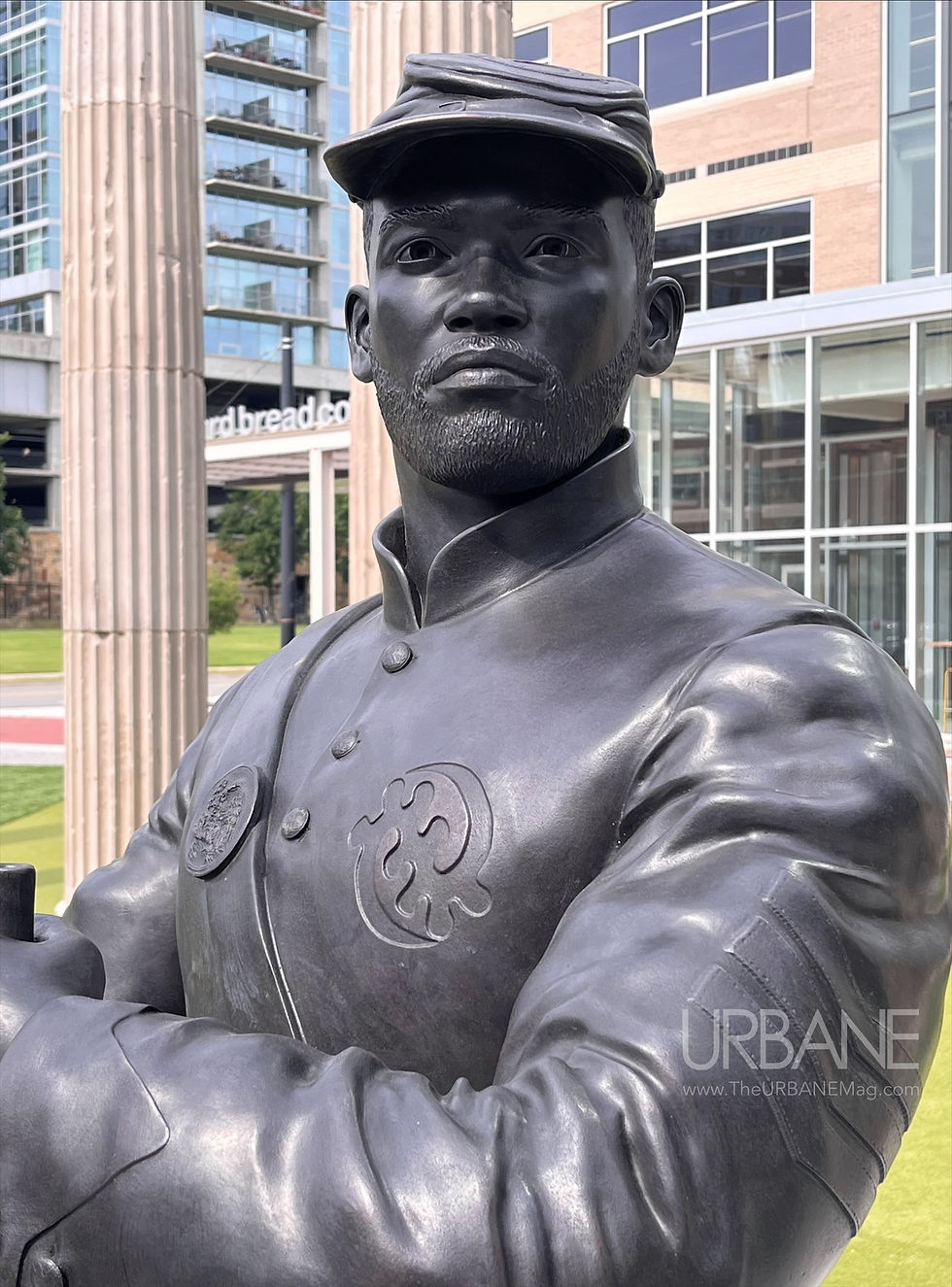

In the heart of downtown Little Rock, a new monument now stands as a powerful reminder that some of America’s most important stories have too often gone untold.
On June 3, Arkansas’s Heroes was unveiled in Library Square, honoring over 5,500 Black soldiers from Arkansas who served in the Union Army during the Civil War. For many, the bronze figure – "Carter," as its creator affectionately knows the sculpture – is more than a work of art. It is a long-overdue acknowledgment of men who fought not only for the preservation of the Union, but for the promise of freedom itself.
As Juneteenth nears, the unveiling of Arkansas's Heroes feels especially significant. The holiday commemorates June 19, 1865, when Union troops arrived in Galveston, Texas, bringing news of freedom to approximately 250,000 enslaved people and enforcing the Emancipation Proclamation. Yet freedom did not arrive on its own. It was carried forward by soldiers willing to fight for it, including thousands of Black men who served in the United States Colored Troops. 5,526 of those Black soldiers who served in the war are documented as Arkansans.
In that context, the monument's placement in downtown Little Rock is more than public art. The story of emancipation cannot be told without public acknowledgment of the Black soldiers who helped make it possible. Nearly 161 years later, Arkansas is ensuring their service stands in plain sight.
Carter is a six-foot-tall bronze statue depicting a well-groomed Black Union soldier standing tall and resolute. Rifle in hand, his head turned slightly to the left, the figure projects both dignity and determination.
His uniform is richly detailed, featuring service stripes on his sleeves, the Gye Nyame over his heart—a Ghanaian symbol meaning “Except God,” representing the supremacy and sovereignty of God in all things. Beneath the collar on the back of his uniform is the Sankofa symbol, a reminder to “look to the past to inform the future.”
The sculpture is further adorned with period military regalia, including a belt buckle and a waist bag emblazoned with the letters “US,” reinforcing both his service and his place within the story of the nation he helped preserve.

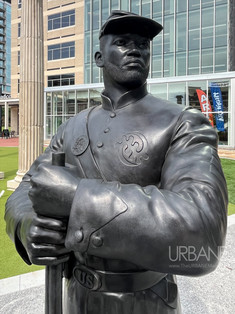


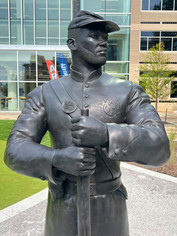


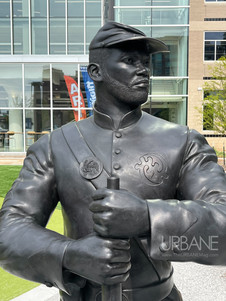



Additionally, the sculptor included “111,116…” along the bottom front corner of his coat and Braille at the opposite corner that translates to “Unlearn hate.” An outline of an unshackled left hand with a broken chain attached to it over the top of “May 22, 1863,” is also debossed, signifying the day the United States War Department issued General Order No. 143, establishing the Bureau of Colored Troops. This was a major legislative step toward formalizing the recruitment and organization of African American soldiers for federal service in the Union Army.
He stands in the center of a rounded granite slab with “Arkansas’s Heroes” rightfully engraved around his feet. His presence is quiet power and invites a moment of reflection – to remember – those whom history seeks to overlook.
The dedication of the monument comes as the nation approaches its 250th birthday and continues to reckon with the full scope of its history. While Civil War narratives have traditionally centered on generals, politicians, and battlefield strategy, the stories of Black soldiers have often remained in the margins. Arkansas’s Heroes is positioned to change that.
To understand why the monument matters, one must first understand the men it honors. Many of the men represented by the monument had only recently emerged from slavery when they answered President Abraham Lincoln’s call to serve. Following the Emancipation Proclamation in 1863, thousands of Black Arkansans enlisted in the United States Colored Troops (USCT), becoming part of a force that would ultimately help reshape the nation.
Across the country, approximately 180,000 Black men joined the Union cause. An estimated 40,000 lost their lives during the conflict. Lincoln later credited these soldiers—whom he famously called the “sable arm”—with helping turn the tide of the war. Arkansas’s contribution to this force included frontline fighters, as well as thousands more serving throughout the state in artillery, cavalry, infantry, and naval assignments. Their service was marked by extraordinary courage and sacrifice.
Black soldiers fought despite knowing they faced dangers beyond those of combat. Confederate authorities declared that captured Black Union soldiers could be executed rather than treated as prisoners of war. Yet they continued to enlist and fight.
They served in garrisons at Helena, Little Rock, Pine Bluff, Fort Smith, and DeValls Bluff. They guarded supply routes, protected strategic positions, and participated in dozens of battles and skirmishes throughout Arkansas and surrounding territories. Their presence challenged deeply rooted beliefs about race, citizenship, and who was worthy of fighting for the nation.
Time and again, they proved themselves in combat. Military leaders praised their bravery. Journalists wrote of their determination. Fellow soldiers who had once doubted them witnessed their valor firsthand. From Helena to Jenkins’ Ferry, Black troops demonstrated a level of commitment that forced even skeptics to reconsider long-held prejudices.
Their sacrifices came at a steep cost. At Poison Spring in 1864, Black soldiers suffered devastating casualties. Many who were wounded or captured were executed on the battlefield. The brutality of the attack became a rallying cry among surviving troops, who vowed to “Remember Poison Spring.” Yet despite these horrors, Black regiments continued to serve with distinction until the war’s end. Their story is not simply one of military service, but of transformation.
For men who had been denied freedom, citizenship, education, and basic human rights, wearing the uniform of the United States Army represented something larger than enlistment. It was a declaration of personhood and belonging. Their service helped lay the groundwork for a new understanding of American citizenship, one that increasingly recognized Black Americans as participants in the nation’s future rather than property within it.
That is why Arkansas’s Heroes matters.
Created by acclaimed sculptor and New York native Vinnie Bagwell, the monument stands not merely as a tribute to the past but as a teaching tool for future generations. It invites visitors to learn about a chapter of history that belongs to all Americans.
It follows earlier efforts to recognize Black Union soldiers, including a memorial erected in Helena-West Helena in 2013. Yet Arkansas’s Heroes brings this history to one of the state’s most visible public spaces, ensuring that the contributions of these soldiers become part of the everyday landscape of Arkansas’s capital city.
Black soldiers of Arkansas, America's legacy deserves nothing less.
The men of the United States Colored Troops fought for a country that had not yet fully recognized their humanity. They marched into battle knowing freedom was not guaranteed, and survival was uncertain. Still, they served. Today, their courage stands in Carl and Lorene Martin Plaza outside the Main Library in downtown Little Rock, cast in bronze for all to see.
This is American history. Not just Black history.
A full expansion of this article will be featured as an Arkansas Black History feature of Issue 33, set to release on August 1st, 2026. Be sure to check back for information on how to pre-order!
sources:
https://encyclopediaofarkansas.net/entries/black-union-troops-5135/
https://robertslibrary.org/usct-monument/